10,000 Steps to Miles: How Far Is 10,000 Steps?
The short answer
- 10,000 steps is about 4 to 5 miles (6.3 to 8 km) for most adults.
- At 5'4" it's around 4.2 miles. At 6'0" it's around 4.7 miles.
- Walked in one go at a steady pace, it takes about 1.5 to 2 hours.
- The 10,000 target started as a pedometer brand name in 1960s Japan, not as a medical rule.
How far 10,000 steps takes you depends on how long your steps are. Taller people and faster walkers cover more ground with each one. For an average adult, it works out to a little over 4 miles.
How many miles is 10,000 steps, by height
These use the common estimate that walking stride is about 41.4% of your height:
| Height | Miles | Kilometers |
|---|---|---|
| 5'0" | 3.9 | 6.3 |
| 5'2" | 4.1 | 6.5 |
| 5'4" | 4.2 | 6.7 |
| 5'6" | 4.3 | 6.9 |
| 5'8" | 4.4 | 7.1 |
| 5'10" | 4.6 | 7.4 |
| 6'0" | 4.7 | 7.6 |
| 6'2" | 4.8 | 7.8 |
| 6'4" | 5.0 | 8.0 |
Want your exact number? Plug your height into the steps to miles calculator.
How long does it take to walk 10,000 steps?
A steady, moderate walk is often around 100 steps a minute. At that rate, 10,000 steps takes about 100 minutes, or a bit under an hour and 45 minutes. A slower stroll pushes it toward 2 hours. Brisk walkers might finish in 80 to 90 minutes.
Most people don't do it in one walk, though. Steps add up through the day: getting coffee, walking the dog, wandering the grocery store. A 30-minute walk adds roughly 3,000 steps on top of whatever you already do.
Where 10,000 came from
The number goes back to a pedometer sold in Japan in the mid-1960s called the manpo-kei, which translates to "10,000 steps meter". It was a catchy round number, and it stuck.
Research since then has looked at what step counts actually do for health. A 2022 analysis in The Lancet Public Health pooled 15 studies of about 47,000 adults. More steps went with a lower risk of death, but the benefit leveled off at about 6,000 to 8,000 steps a day for adults 60 and older, and about 8,000 to 10,000 for younger adults. An earlier study of older women in JAMA Internal Medicine (2019) found the benefit leveled off around 7,500 steps.
So 10,000 isn't magic. It's a reasonable target if you're under 60, and fewer steps still count for a lot.
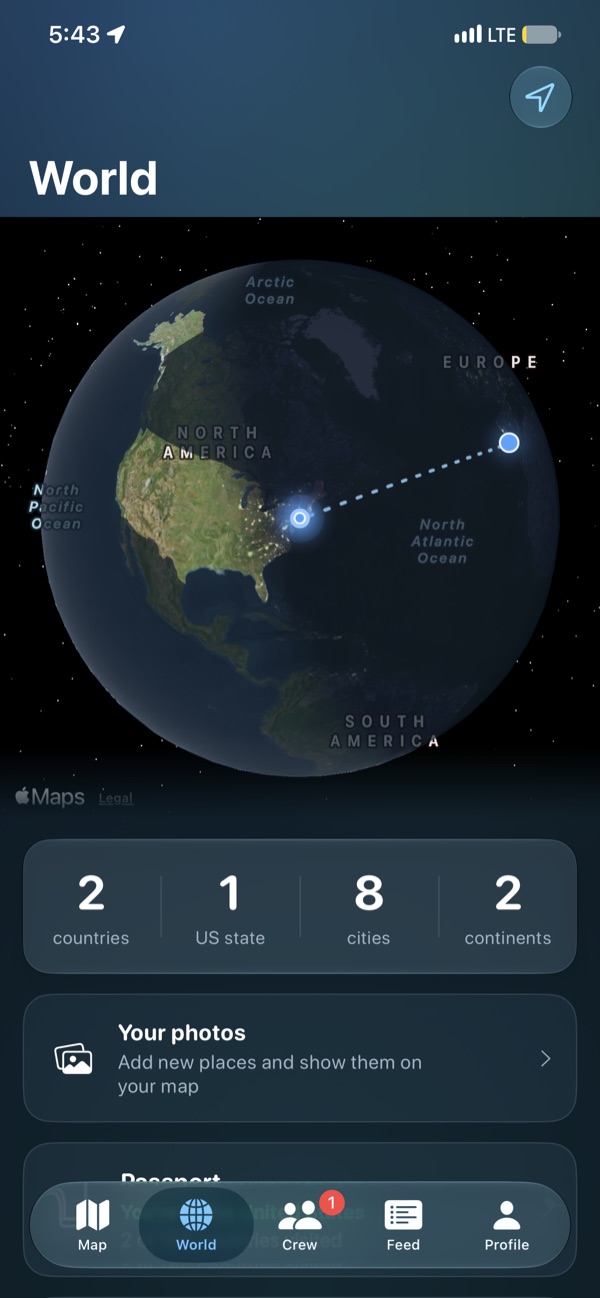
Glowtrail turns every walk into a map. The streets you walk light up, and your countries, states and cities fill in on a 3D globe.
See the appMaking 10,000 steps less boring
The hard part of a daily step goal usually isn't the distance. It's walking the same loop every day until it feels like a chore. A few ways to change that:
- Walk a street you've never been down. Even in a neighborhood you've lived in for years, there are usually a few. Glowtrail shows them as the dark parts of your map.
- Break it into a morning, lunch and evening walk of about 3,000 steps each.
- Pick a destination instead of a distance. A coffee shop 2 miles away and back is roughly 8,000 to 10,000 steps.
- Try a month-long plan. Our 30-day walking challenge builds up slowly.
Questions people ask
Is 10,000 steps 5 miles?
Only for tall people or fast walkers. For most adults it's closer to 4 to 4.5 miles.
How many steps is 5 miles?
Roughly 10,000 to 12,700 steps, depending on height and pace.
Do I need 10,000 steps a day?
Large studies found the health benefit levels off around 6,000 to 8,000 steps for adults over 60 and 8,000 to 10,000 for younger adults. Any increase from where you are now helps.
Sources: Paluch et al., "Daily steps and all-cause mortality", The Lancet Public Health (2022); Lee et al., "Association of Step Volume and Intensity With All-Cause Mortality in Older Women", JAMA Internal Medicine (2019). Distances use the height × 0.414 stride estimate.